If you are evaluating church management software for a Philippine church, you are staring at a landscape dominated by US platforms. Planning Center, Tithely, Subsplash, Pushpay, ChurchTrac — all good products, all built for a market that assumes USD pricing, Stripe merchant accounts, and ACH settlement.
This guide is written for pastors, finance committees, and church administrators in the Philippines. It focuses on the questions that actually matter in our context — not just the feature bullets on a sales page.
Question 1: Can Donors Actually Pay You Through It?
This is the question that disqualifies most US platforms for Philippine churches. Planning Center Giving operates in the US, Canada, Australia, and New Zealand only. Tithely's published country list adds Singapore, Japan, Hong Kong, and the UK, but the Philippines is not on it. ChurchTrac uses Stripe, which does not list the Philippines as a fully supported merchant country.
Before you go any further down the feature comparison, confirm:
Is the platform's giving module available to a Philippine-registered church?
Does it support GCash, Maya, or QR Ph — the three methods most of your congregation already uses?
Where do settled funds go? A Philippine bank account, or a US/Stripe merchant account that needs remittance?
A church management platform without working local giving is an expensive membership database.
Question 2: Is It Priced in Philippine Peso?
USD pricing creates three hidden costs:
FX markup — most card issuers charge 1–2% on international transactions, on top of the subscription.
Exchange rate risk — your budget line item moves with the peso-dollar rate.
Payment friction — some Philippine-issued cards silently decline USD merchants, especially for recurring charges.
A subscription priced in PHP eliminates all three.
Question 3: Does It Understand Philippine Church Operations?
Philippine churches have operational rhythms that US software does not always anticipate:
Simbang Gabi — nine-day novena masses that are treated as a single liturgical series, not nine independent events.
Kapatiran and ministry structures — often flatter than US-style committees, with rotating lay leadership.
Barangay-level outreach — small-area evangelism that needs geographic tracking beyond a simple address field.
Bilingual communications — service bulletins and announcements often mix Tagalog, English, and regional languages.
A software built for American mid-size churches may handle English-language Sunday services fine but stumble on the rest.
Question 4: What Happens to Data If You Leave?
Every platform promises easy import. Fewer promise easy export. Before signing a contract, ask:
Can the church export all member, giving, and event data in a machine-readable format?
Is there a fee or process gate for full export?
How long is data retained after you cancel?
The answer you want: CSV export of everything, at any time, at no charge. If the answer is "contact support for a data export," consider that a warning sign.
Question 5: What Is the Total Cost of Ownership?
The subscription price is only the start. A complete cost-of-ownership estimate includes:
Subscription — monthly or annual, in whatever currency
Payment processing fees — per donation, which scale with your giving volume
Add-on modules — US platforms often split giving, membership, check-ins, and events into separate per-module subscriptions
Staff time — manual reconciliation between systems that do not talk to each other is a real cost
Migration cost — if you switch later
A Philippines-built all-in-one platform may have a higher sticker subscription than a US entry tier, but a lower total cost once you add processing and integration time.
Question 6: Who Do You Call at 11pm?
US platforms provide excellent support — during US business hours. A critical issue during your Saturday evening service can mean waiting until Monday Pacific Time for a response. A Philippines-based team working GMT+8 is reachable when you actually need them.
Question 7: Does It Support Multi-Tenant Networks?
Many Philippine churches are part of denominations or church networks with shared oversight. If your church is part of a larger fellowship, ask whether the platform supports multi-tenant deployment — where each local church has its own data but the denomination can aggregate reports.
How StewardTrack Addresses These
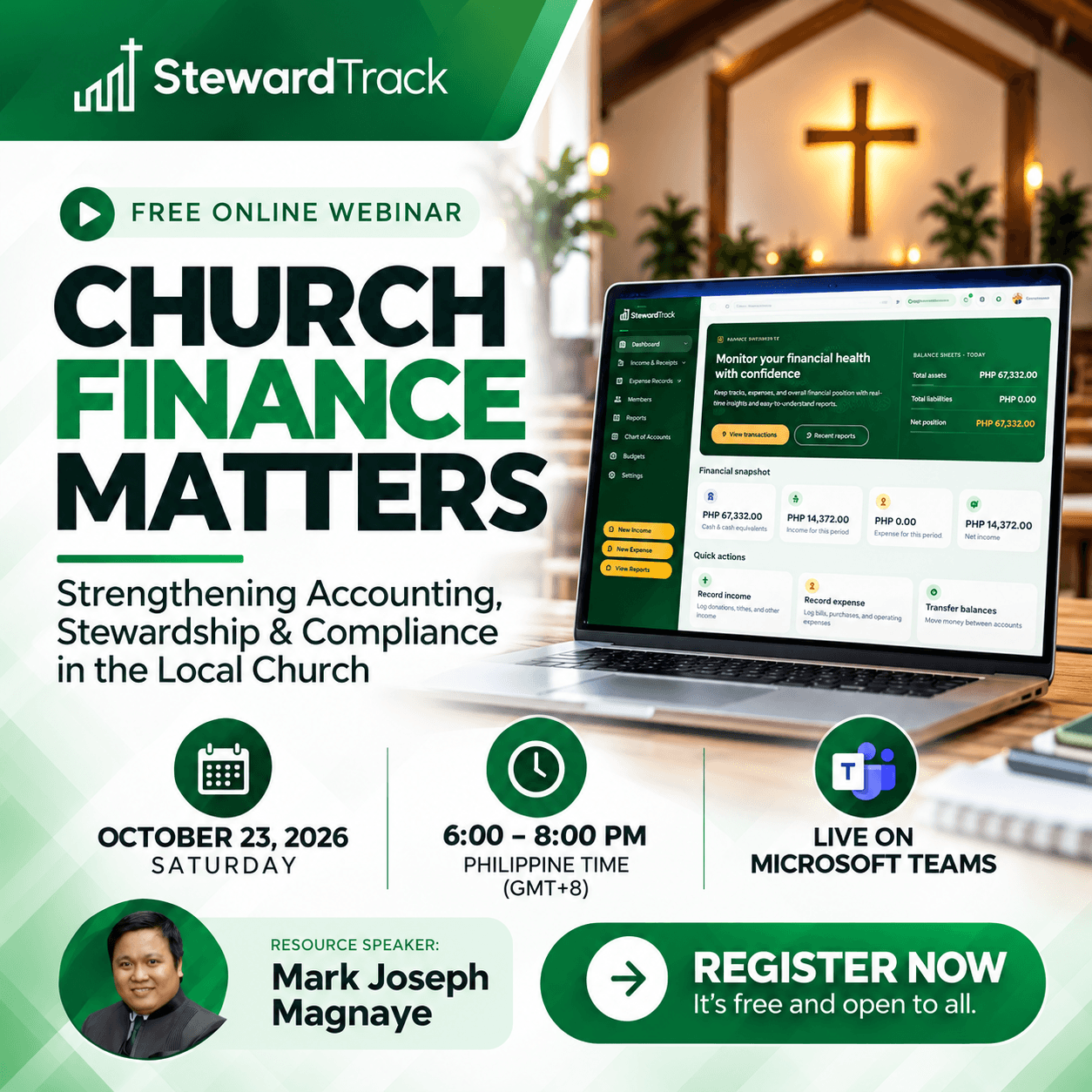
StewardTrack was built in the Philippines specifically to answer these questions:
Online giving via Xendit, supporting GCash, Maya, QR Ph, card, and bank transfer — settled to your own Philippine bank account via Xendit.
Subscription priced in PHP.
Philippines-based product and support team.
Multi-tenant architecture for church networks and denominations.
Full CSV export at any time, no gate.
We also publish detailed, fact-checked comparisons with the major international options — see our pages on Planning Center, Tithely, Subsplash, ChurchTrac, and Pushpay.
If you want to see how it feels, start a free trial. The Essential plan is free for small churches.